24 Exercises for ‘Everything is regression’ chapter
Note: we suggest that you do not complete this assignment immediately after reading the ‘Everything is regression’ chapter, but instead return to it later after you have read all of Part 1 of the book (learning how to simulate).
In a blog post, Jonas Lindeløv’s points out that most common statistical tests are linear models.
In the ‘Everything is regression’ chapter, we took several of these ‘named tests’ and showed that they were equivalent to linear regression models using lm(), e.g., for their p-value or effect size estimate.
We did this for:
- Mean and standard deviations
- Pearson’s r correlations
- Spearman’s rho correlations
- Students’ t-tests
- Mann-Whitney U-tests
- (Equal effects) meta-analyses
This also holds for other tests, including different forms of ANOVA and (if we move from linear models to generalized linear models) Chi-square tests among other things. Lindeløv summarizes this in a useful infographic:
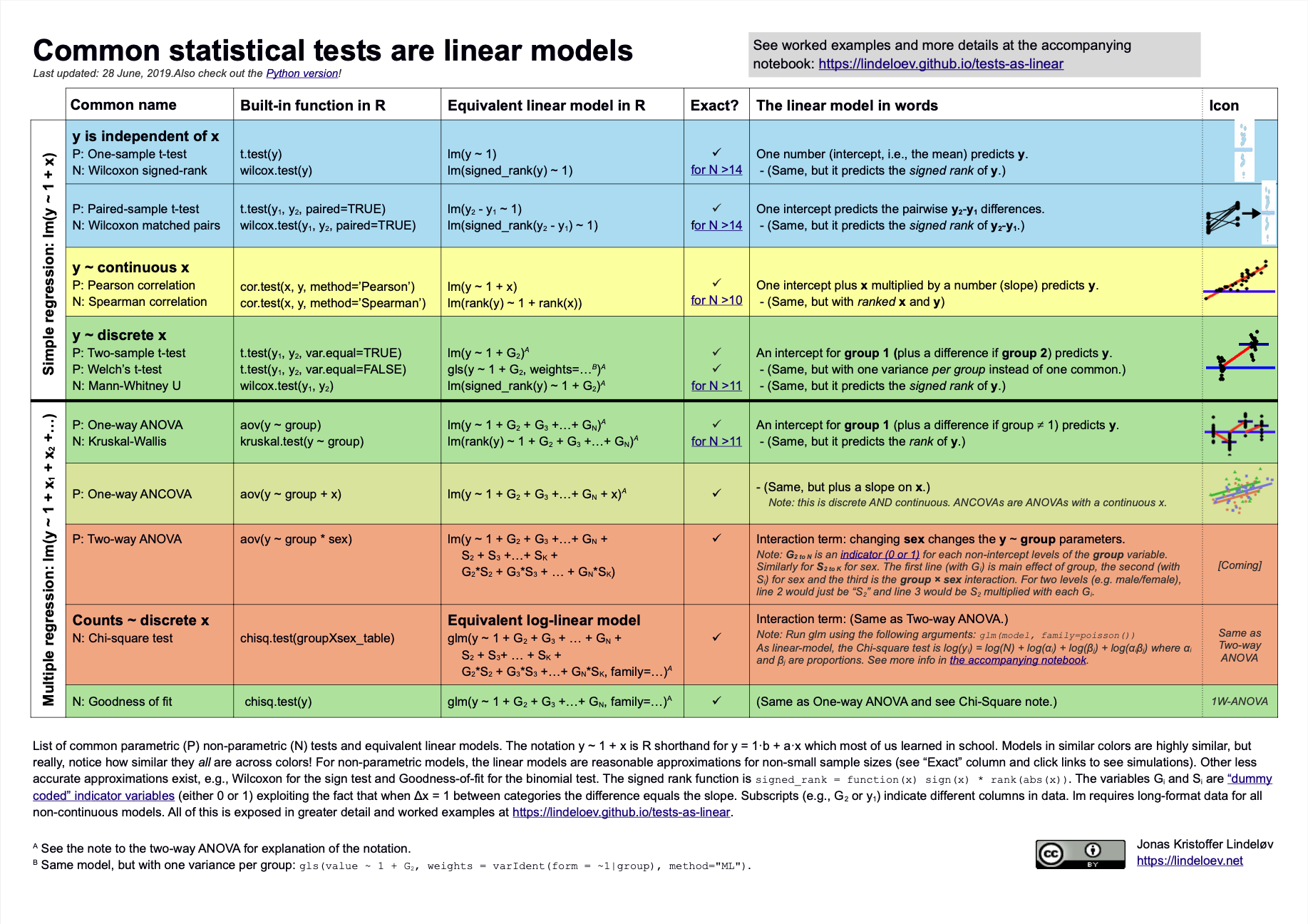
However, in the chapter, we only compared each named test with linear regression using a single dataset.
… A single dataset? In a course on simulation, where you learn to validate statistical methods by simulating thousands of datasets under a variety of different conditions??

In this set of exercises, we suggest that you practice the skills you learned in the chapters in Part 1 by implementing simulations to test the equivalence between named tests and linear models.
Choose one or more named tests, generate data from a suitable DGP, and fit both the named test and the linear regression to each dataset. Test for equivalence of the results between them, across a range of experiment conditions and a large number of iterations.
Note that when checking if two p values are equivalent you will run into the weirdness of “floating point arithmetic”. Instead of doing something like mutate(p_values_match = p_named_test == p_lm) instead use dplyr::near(), e.g., mutate(p_values_match = near(p_named_test, p_lm) (see Ian’s other book for more)](https://ianhussey.quarto.pub/reproducible-data-processing-and-visualization/chapters/strings_and_factors.html). You might also want to round each p value to (for example) five or six decimal places before testing for equivalence.