# Exercises for 'Estimation' chapter
```{r}
#| include: false
# if it is available, run the setup script that tells quarto to round all df/tibble outputs to three decimal places
if(file.exists("../_setup.R")){source("../_setup.R")}
```
```{r}
#| include: false
# dependencies
library(tidyr)
library(dplyr)
library(readr)
library(furrr)
library(parameters)
library(stringr)
library(forcats)
library(ggplot2)
library(scales)
library(ggstance)
library(patchwork)
library(janitor)
library(effectsize)
library(ggstance)
library(knitr)
library(kableExtra)
# set up parallelization
# use availableCores() to define the number of cores, in case the simulation is being
# run on a HPC that might have more physical cores than are available to the session
plan(multisession, workers = parallelly::availableCores())
```
## Basis simulation
Same as in the chapter.
```{r}
# functions for simulation
generate_data <- function(n_per_condition,
                          mean_control,
                          mean_intervention,
                          sd) {

  data_control <-
    tibble(condition = "control",
           score = rnorm(n = n_per_condition, mean = mean_control, sd = sd))

  data_intervention <-
    tibble(condition = "intervention",
           score = rnorm(n = n_per_condition, mean = mean_intervention, sd = sd))

  data_combined <-
    bind_rows(data_control,
              data_intervention) |>
    mutate(condition = factor(condition, level = c("intervention", "control")))

  return(data_combined)
}

analyse <- function(data){
  fit <- t.test(
    formula = score ~ condition,
    var.equal = TRUE, # students t test: assumes equal variances
    data = data
  )

  results <- fit %>%
    model_parameters() %>%
    as_tibble() %>%
    janitor::clean_names() %>%
    # create estimand
    mutate(confidence_interval_width = ci_high - ci_low) |>
    # select columns of interest
    select(mean_diff = difference, # for parameter recovery
           ci_low, # for plotting
           ci_high, # for plotting
           confidence_interval_width) # the estimand

  return(results)
}

# simulation parameters
experiment_parameters <- expand_grid(
  n_per_condition = seq(from = 10, to = 100, by = 10),
  mean_control = 4,
  mean_intervention = 5,
  sd = 1.5,
  iteration = 1:1000
)

# run simulation
# results are cached to disk: the simulation is only run the first time, and read back
# in on subsequent renders. delete the .rds file if you change the simulation code.
dir.create("results", showWarnings = FALSE)

if(file.exists("results/simulation_estimation_exercises.rds")){

  simulation <- read_rds("results/simulation_estimation_exercises.rds")

} else {

  # set seed
  set.seed(43)

  simulation <- experiment_parameters |>
    # shuffle the rows of the grid to load balance the computationally expensive
    # iterations evenly across the workers
    slice_sample(prop = 1) |>
    mutate(generated_data = future_pmap(.l = list(n_per_condition = n_per_condition,
                                                  mean_control = mean_control,
                                                  mean_intervention = mean_intervention,
                                                  sd = sd),
                                        .f = generate_data,
                                        .progress = TRUE,
                                        .options = furrr_options(seed = TRUE))) |>
    mutate(results = future_pmap(.l = list(data = generated_data),
                                 .f = analyse,
                                 .progress = TRUE,
                                 .options = furrr_options(seed = TRUE))) |>
    # undo the shuffle so the rows are back in the order of the experiment grid
    arrange(n_per_condition, iteration) |>
    # the generated data sets are not needed after they have been analyzed, and keeping
    # them would make the saved file enormous
    select(-generated_data)

  write_rds(x = simulation,
            file = "results/simulation_estimation_exercises.rds",
            compress = "gz")

}

# summarise results
results_summary <- simulation |>
  unnest(results) |>
  group_by(n_per_condition) |>
  summarize(mean_difference_in_means = mean(mean_diff),
            mean_ci_low = mean(ci_low),
            mean_ci_high = mean(ci_high),
            mean_confidence_interval_width = mean(confidence_interval_width))

## table
## remember: only round results as you're about to print a table
results_summary |>
  mutate_if(is.numeric, round, digits = 1)
## Difference-in-means
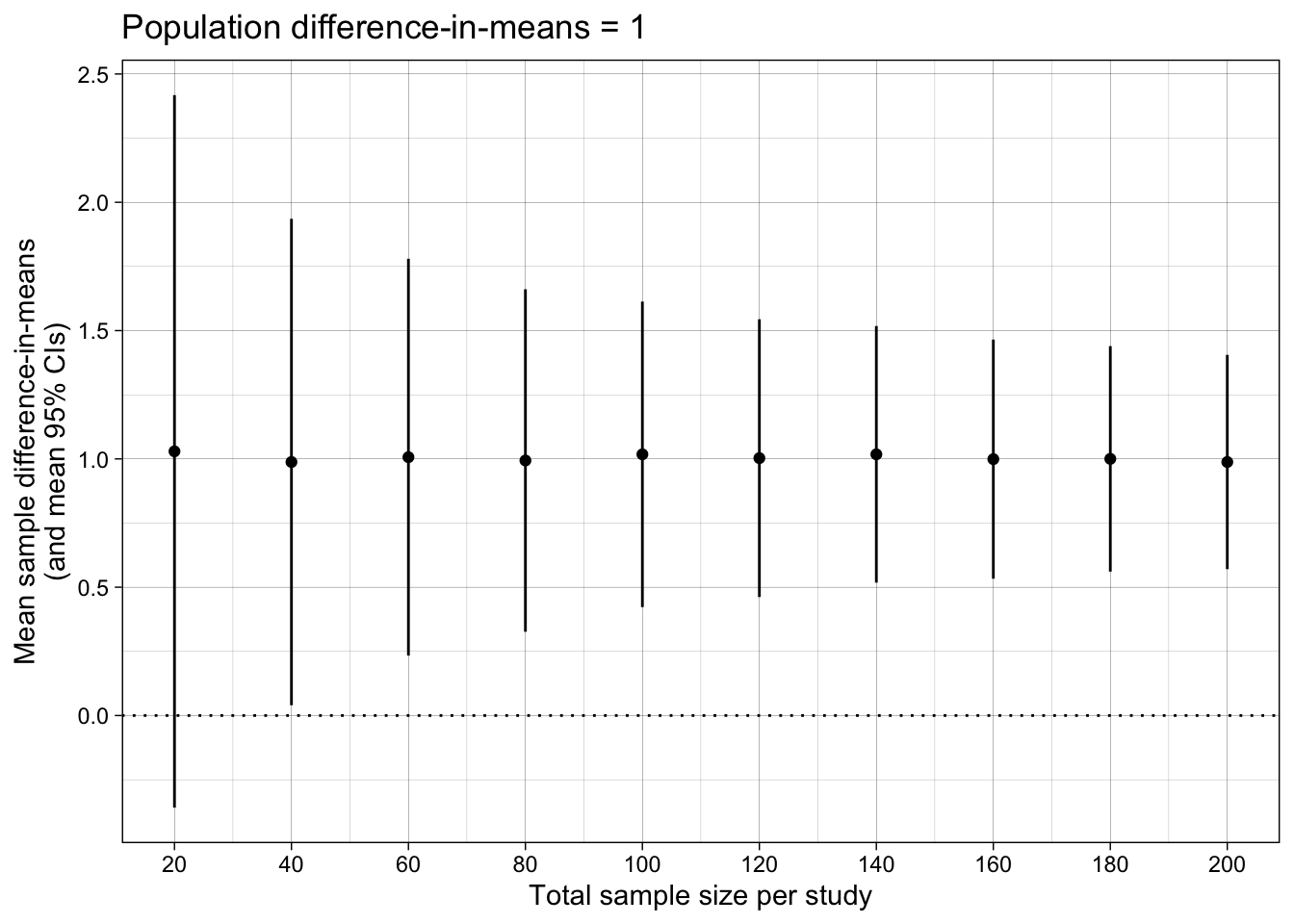
ggplot(results_summary, aes(n_per_condition*2, mean_difference_in_means)) +
  geom_point() +
  geom_linerange(aes(ymin = mean_ci_low, ymax = mean_ci_high)) +
  geom_hline(yintercept = 0, linetype = "dotted") +
  scale_x_continuous(breaks = breaks_pretty(n = 10),
                     name = "Total sample size per study") +
  scale_y_continuous(breaks = breaks_pretty(n = 5),
                     #limits = c(0,1),
                     name = "Mean sample difference-in-means\n(and mean 95% CIs)") +
  theme_linedraw() +
  ggtitle("Population difference-in-means = 1")
## Difference-in-means' 95% Confidence Interval width
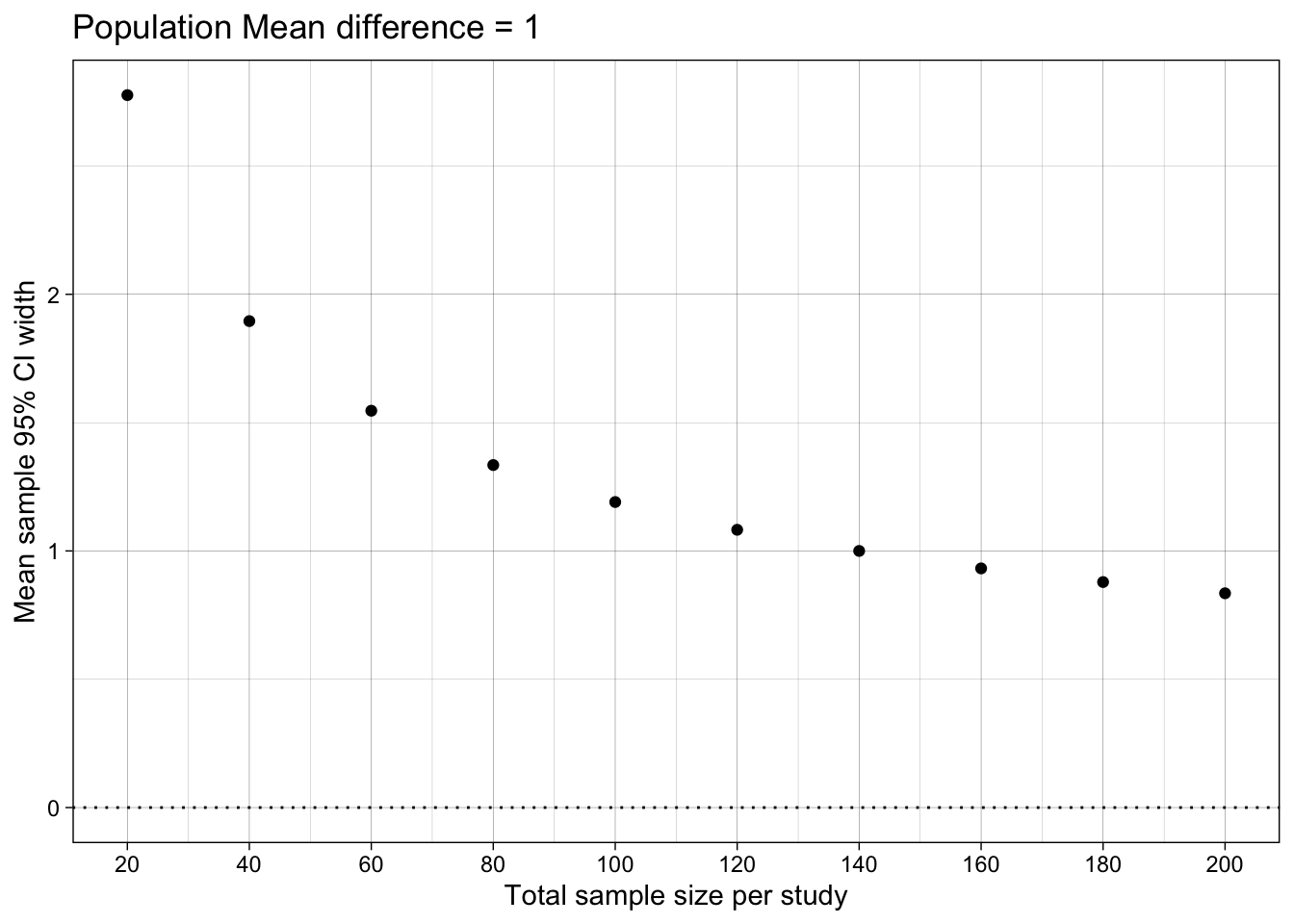
ggplot(results_summary, aes(n_per_condition*2, mean_confidence_interval_width)) +
  geom_hline(yintercept = 0, linetype = "dotted") +
  #geom_linerange(aes(ymin = min_ci_width, ymax = max_ci_width)) +
  geom_point() +
  #scale_y_continuous(name = "95% CI width\n(mean [min, max])", limits = c(0, NA)) +
  scale_y_continuous(name = "Mean sample 95% CI width",
                     limits = c(0, NA)) +
  scale_x_continuous(breaks = breaks_pretty(n = 9),
                     name = "Total sample size per study") +
  theme_linedraw() +
  scale_color_viridis_d(begin = 0.3, end = 0.7) +
  ggtitle("Population Mean difference = 1")
```
## Exercises
For each of the exercises below, create a copy of the simulation above. Modify it appropriately to answer the exercise.
### For each sample size, what proportion of the 95% Confidence Intervals exclude 0?
Use `between()`.
### When the population difference in means is 1, what proportion of the p values are statistically significant for each sample size?
Also have the analysis extract a p-value for the difference in means.
Think about it: what statistical property does this represent?
### What is the relationship between the confidence interval excluding 0 and the significance of the p value?
For each iteration, calculate if (95% CI!=0) == (p<.05)
### When the population difference in means is 0, what proportion of the p values are statistically significant for each sample size?
Change the population effect difference-in-means to zero.
Think about it: what statistical property does this represent?