library(tidyr)
library(dplyr)
library(purrr)
library(parameters)
library(lavaan)
library(semPlot)20 Regression assumes causality ✎ Very rough draft
20.1 Dependencies
20.2 Functions
generate_data <- function(n, population_model) {

  data <- lavaan::simulateData(model = population_model, sample.nobs = n)

  return(data)
}

analyse <- function(data, model) {

  # specify and fit model
  fit <- sem(model = model, data = data)
  #fit <- lm(formula = mode, data = data)

  # extract regression beta estimates
  results <- parameters::model_parameters(fit, standardize = FALSE) |>
    filter(To == "Y" & From == "X") |>  # this corresponds to the Y ~ X effect
    select(beta = Coefficient,
           ci_lower = CI_low,
           ci_upper = CI_high,
           p)

  return(results)
}

 plots_causal <- function(model){
  generate_data(n = 300, population_model = model) %>%
    sem(model = model, data = .) |>
    semPaths(whatLabels = "diagram",
             layout = layout_matrix,
             residuals = FALSE,
             edge.label.cex = 1.2,
             sizeMan = 10)
}
20.3 Does regression assume causality?
20.3.1 Plots
Simple regression: X causes Y
# simple regression
layout_matrix <- matrix(c( 1,  0,
                           -1,  0),
                        ncol = 2,
                        byrow = TRUE)

plots_causal("Y ~ 0.5*X")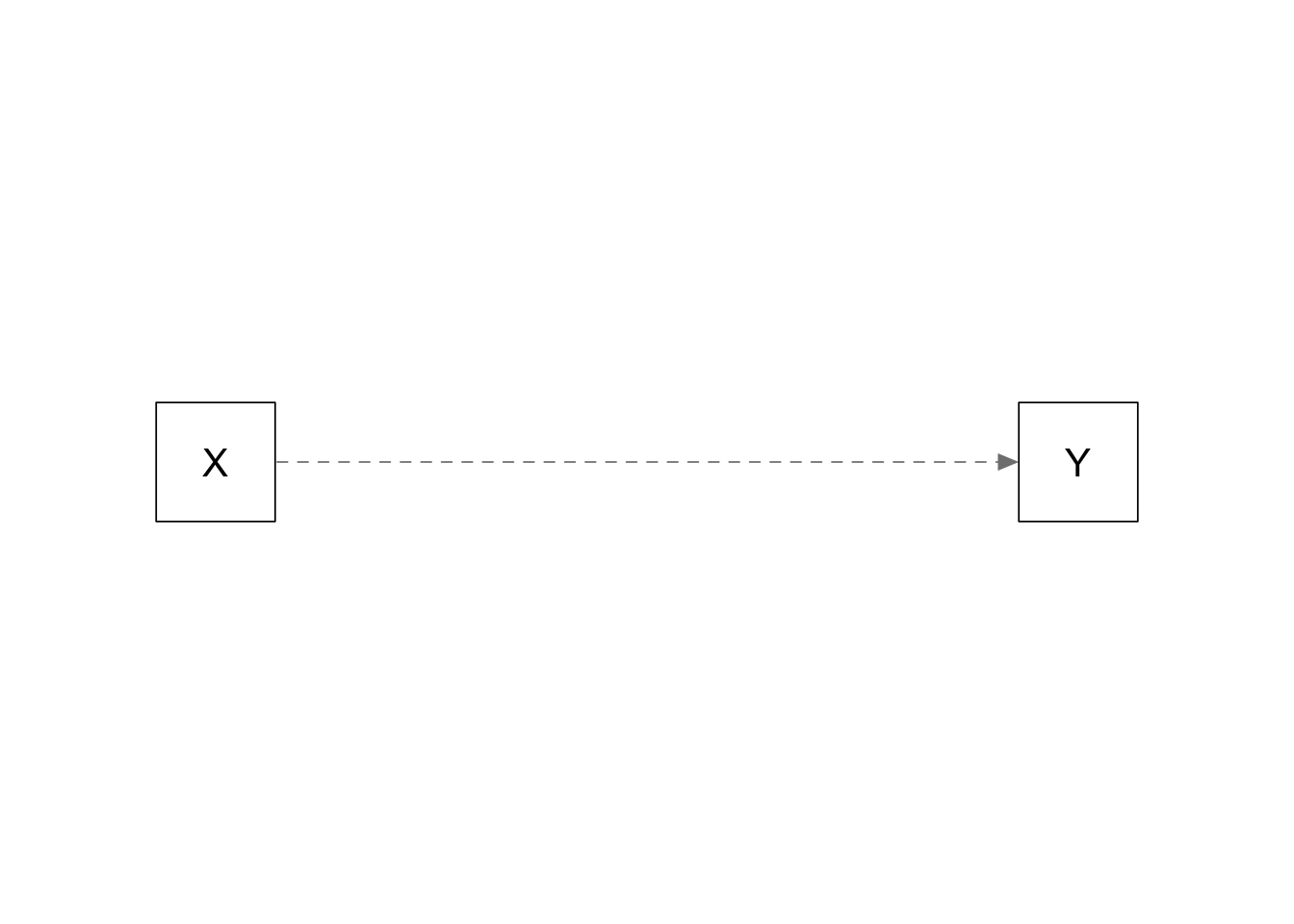
Simple regression: Y causes X
# simple regression
layout_matrix <- matrix(c(-1,  0,
                           1,  0),
                        ncol = 2,
                        byrow = TRUE)

plots_causal("X ~ 0.5*Y")
20.3.2 Run simulation
experiment_parameters_grid <- expand_grid(
  n = 200,
  population_model = c("Y ~ 0.5*X",
                       "X ~ 0.5*Y"),
  analyse_model = "Y ~ X",
  iteration = 1:1000
)

set.seed(42)

simulation <-
  # using the experiment parameters...
  experiment_parameters_grid |>

  # ...generate data...
  mutate(generated_data = pmap(list(n = n,
                                    population_model = population_model),
                               generate_data)) |>
  # ...analyze data
  mutate(results = pmap(list(data = generated_data,
                             model = analyse_model),
                        analyse))
20.3.3 Summarize results
simulation_summary <- simulation |>
  unnest(results) |>
  group_by(n,
           population_model,
           analyse_model) |>
  summarize(mean_beta = mean(beta),
            proportion_signficiant = mean(p < .05))

simulation_summary |>
mutate_if(is.numeric, janitor::round_half_up, digits = 2)| n | population_model | analyse_model | mean_beta | proportion_signficiant |
|---|---|---|---|---|
| 200 | X ~ 0.5*Y | Y ~ X | 0.4 | 1 |
| 200 | Y ~ 0.5*X | Y ~ X | 0.5 | 1 |
20.4 Collider
20.4.1 Plots
Covariate is a confounder:
layout_matrix <- matrix(c( 1,  0,
                           -1,  0,
                           0,  1),
                        ncol = 2,
                        byrow = TRUE)

plots_causal("Y ~ 0.0*X + 0.5*C; X ~ 0.5*C")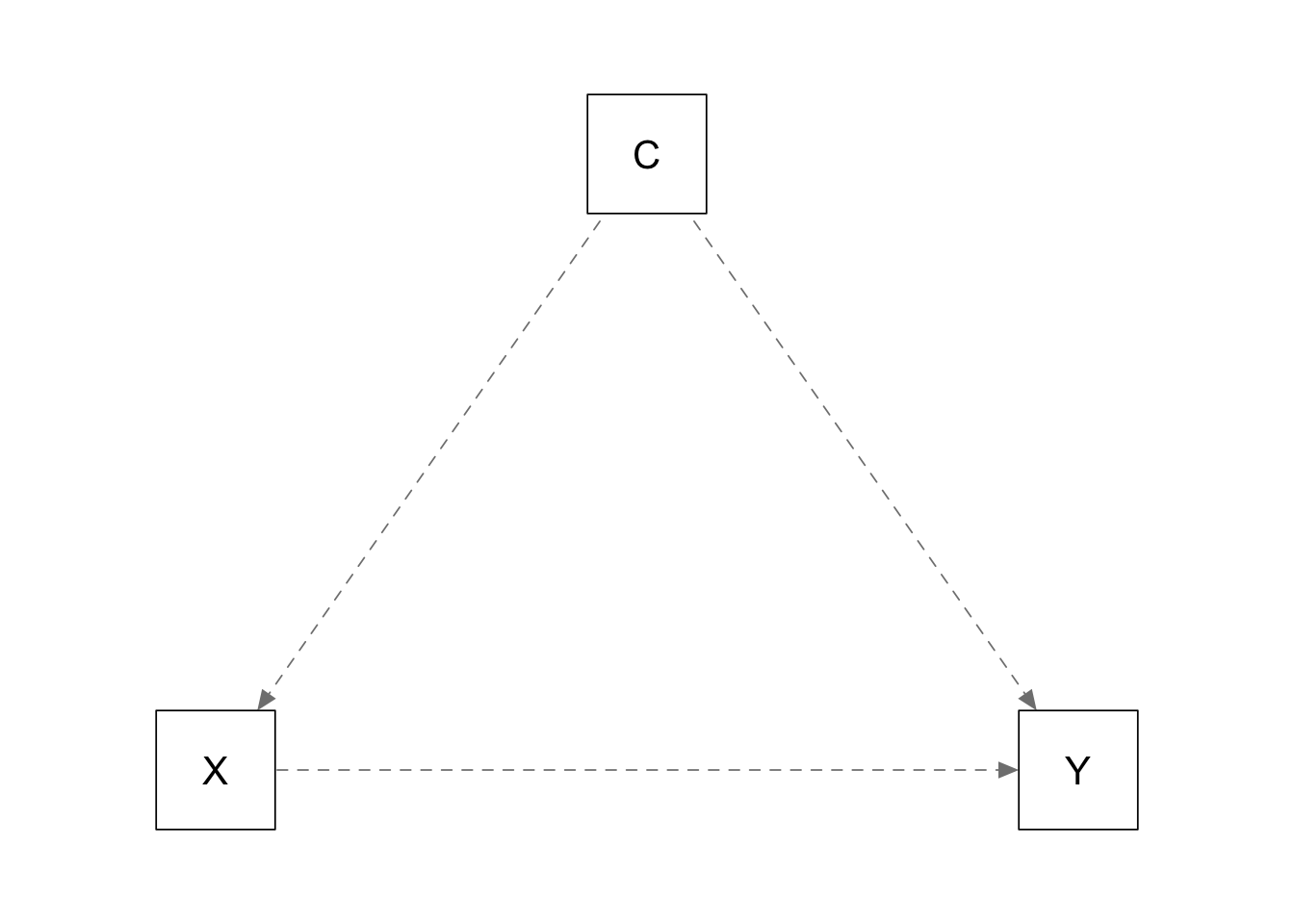
Confounder is a collider:
layout_matrix <- matrix(c( 0,  1,
                           1,  0,
                           -1,  0),
                        ncol = 2,
                        byrow = TRUE)

plots_causal("C ~ 0.5*X + 0.5*Y; Y ~ 0.0*X")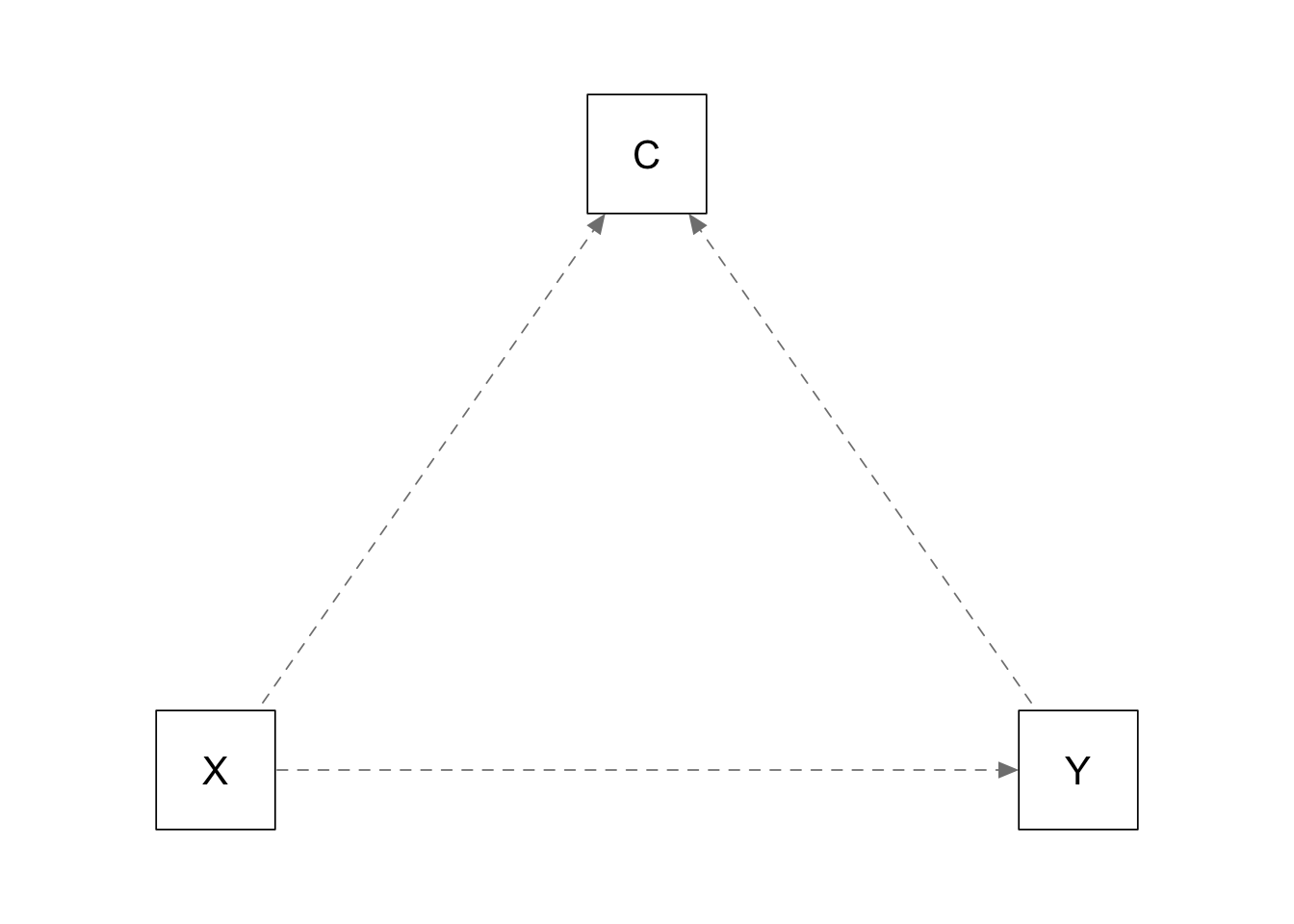
20.4.2 Run simulation
experiment_parameters_grid <- expand_grid(
  n = 200,
  population_model = c("Y ~ 0.5*X + 0.0*C",
                       "C ~ 0.5*X + 0.5*Y; Y ~~ 0.0*X"),
  analyse_model = "Y ~ X + C",
  iteration = 1:1000
)

set.seed(42)

simulation <-
  # using the experiment parameters...
  experiment_parameters_grid |>

  # ...generate data...
  mutate(generated_data = pmap(list(n = n,
                                    population_model = population_model),
                               generate_data)) |>
  # ...analyze data
  mutate(results = pmap(list(data = generated_data,
                             model = analyse_model),
                        analyse))
20.4.3 Summarize results
simulation_summary <- simulation |>
  unnest(results) |>
  group_by(n,
           population_model,
           analyse_model) |>
  summarize(mean_beta = mean(beta),
            proportion_signficiant = mean(p < .05))

simulation_summary |>
mutate_if(is.numeric, janitor::round_half_up, digits = 2)| n | population_model | analyse_model | mean_beta | proportion_signficiant |
|---|---|---|---|---|
| 200 | C ~ 0.5X + 0.5Y; Y ~~ 0.0*X | Y ~ X + C | -0.2 | 0.82 |
| 200 | Y ~ 0.5X + 0.0C | Y ~ X + C | 0.5 | 1.00 |